Download Guide
Women entrepreneurs are critical drivers of economic growth, job creation, and resilience, yet they continue to face systemic barriers in business accelerators and investment readiness programs (IRPs), two key mechanisms for supporting early‑stage and growth‑oriented firms. Despite their potential, women remain underrepresented in these programs and consistently raise less capital than their male peers. These persistent gaps point to the need for more intentional program design and implementation approaches that address gender‑specific constraints and improve women’s participation and fundraising outcomes.
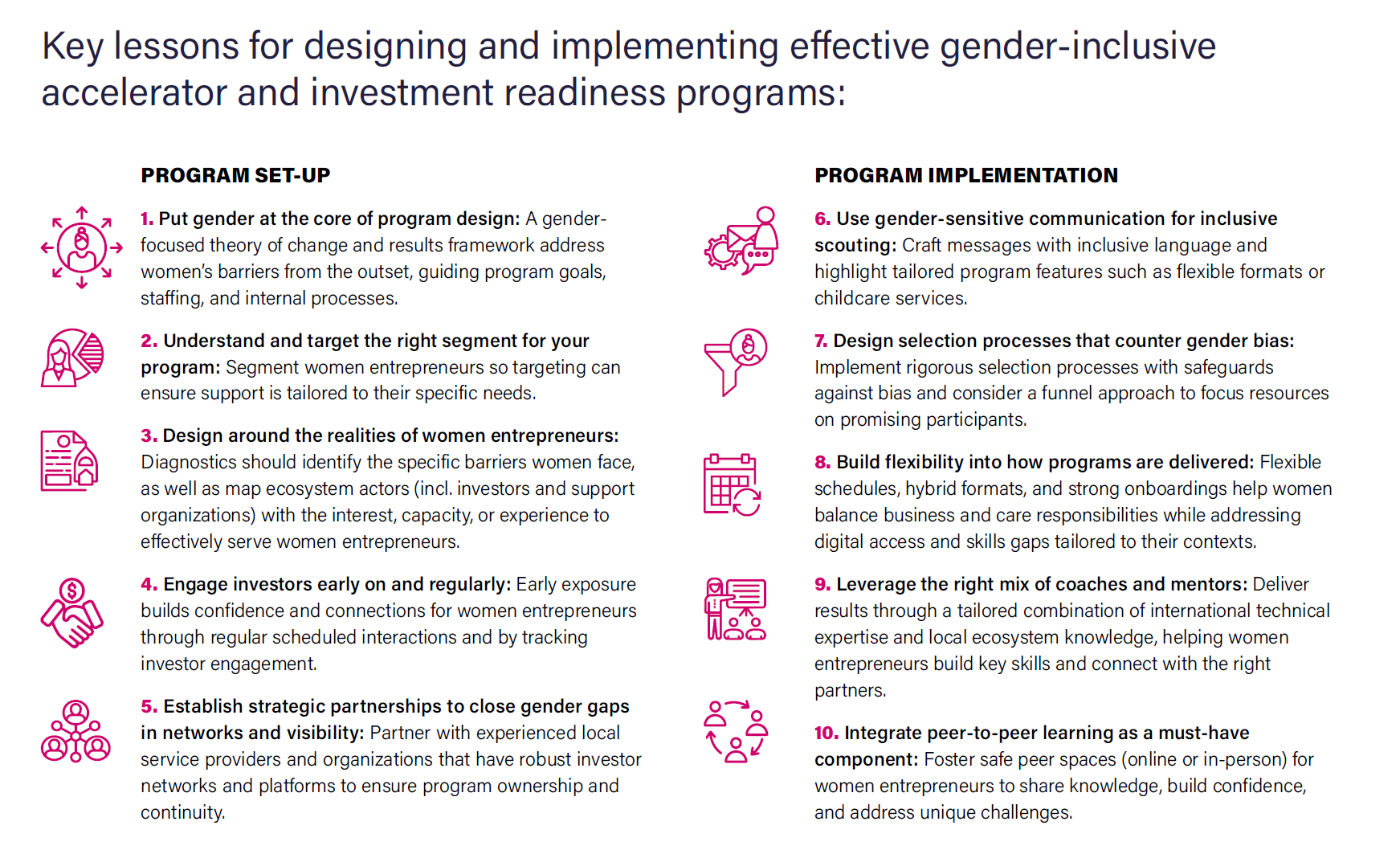
This practitioner’s guide aims to bridge this gap. Drawing on experiences from three We-Fi supported programs, WE3A (implemented by IDB Lab), She WINS Arabia (implemented by IFC), and WeRaise Pakistan (implemented by the World Bank), the guide synthesizes on-the-ground experiences and best practices to identify 10 key lessons across program setup and implementation. To support delivery, the guide also provides actionable tools, templates, and resources for practitioners to design and run programs that work more effectively for women owned and led firms.
As the guide illustrates, strong outcomes start with intentional design choices during program set-up, such as embedding gender from the outset, segmenting participants to ensure the right fit, and engaging investors early. These choices are translated into delivery models that reflect women entrepreneurs’ realities through flexible formats, bias-aware selection processes, qualified coaches, and peer-to-peer learning. When intentionally designed, these programs become more than just support initiatives; they act as essential catalysts for economic transformation. When women-led businesses thrive, they drive job creation, strengthen local resilience, and unlock broader development outcomes that benefit entire economies.